
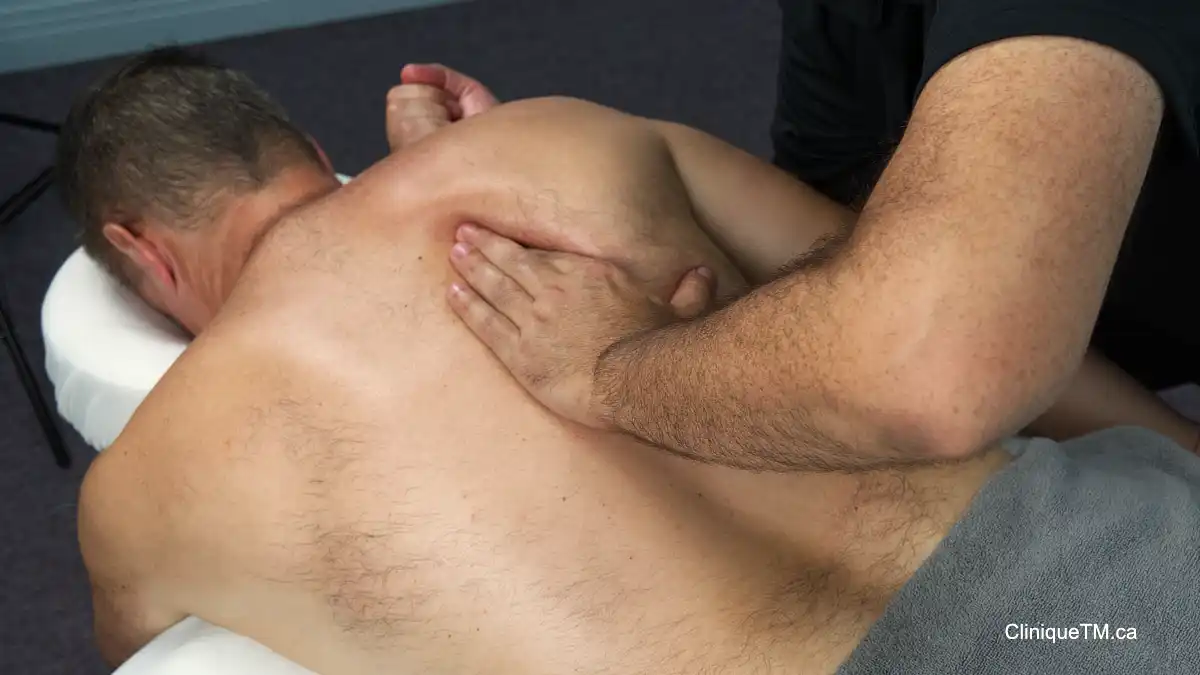
At our clinic, deep tissue massage is one of the most requested forms of massage therapy in Longueuil, and also one of the most misunderstood. Many people assume it simply means “as hard as possible.” It doesn’t. This guide explains what deep tissue massage actually is, how it differs from a regular Swedish massage, what the benefits are, whether it hurts, and when it may not be the right choice.
What is deep tissue massage?
Deep tissue massage is a focused way of working with the deeper layers of muscle and the connective tissue around them. It often uses slower strokes, steady pressure, and focused work on specific muscles or soft tissues. The goal is not simply to press harder. The goal is to reach the appropriate layer of tissue and work there with control.
In a session, the therapist spends more time on specific tight or sore areas instead of moving lightly over the whole body. The work goes deeper, but the point is precision, not maximum force. A session can target the neck, shoulders, back, lower back, hips or legs, depending on where the tension or discomfort actually is.
Deep tissue massage vs Swedish massage
Many people compare deep tissue massage with Swedish massage because Swedish massage is often the basic reference point for a “regular” massage.
Swedish massage usually uses broader, flowing techniques and is often associated with relaxation, circulation, and general well-being. It may use some of the same foundations, but the work is usually slower, more focused, and directed toward deeper or more persistent muscle tension.
| Swedish massage | Deep tissue massage | |
| Main aim | General relaxation | Focused work on tension and deeper layers |
| Pace | Flowing, lighter | Slower, more focused |
| Pressure | Light to moderate | Firmer, but adjusted to the person |
| Typical use | Overall stress and relaxation | Specific tight or sore areas |
| Coverage | Usually full body | Often targeted to the area of complaint |
This does not mean that one is “better” than the other. They have different goals. Some people need a relaxing massage. Others prefer firm, focused work on specific areas of tension. Many sessions can also combine elements of both.
Deep tissue massage is not just stronger pressure
One of the most common misunderstandings is that deep tissue massage simply means “more pressure” — that the therapist should “press as hard as possible.” That is not how it works. Some people go further and believe you should press until bruises appear, as if bruises were a sign the massage is doing you good. This is completely wrong! The goal is not to produce bruises — a bruise means too much force was used, not that the work was effective. The real goal is to release tension and help the muscles and soft tissues move more freely.
The technique — and especially the level of pressure — should be adapted to each person individually. A large, strong man or woman may tolerate moderate pressure very well. But it is not a good idea to use the same force on an older patient, a child, or someone who is more sensitive because of individual sensitivity, pain, inflammation, medication, or another condition.
For this reason, our massage therapist in Longueuil checks during the session how the patient feels the pressure. The work is not as simple as it may seem. For example, the pressure can be increased gradually — starting lighter and going deeper later — but always under control.
How does deep tissue massage work?
Deep tissue massage may improve soft-tissue function by working not only with muscles, but also with the fascia around and within them.
Fascia is connective tissue that surrounds muscles, groups of muscle fibers, individual fibers, nerves, blood vessels, and other structures. It helps tissues slide, supports movement, and transmits mechanical tension through the body.
When fascia becomes less mobile, denser, or more restricted, the area may feel tight, stiff, compressed, or difficult to move. The muscle itself may still be able to contract, but the tissues around it may not glide well. This can limit movement, increase local tension, and sometimes irritate sensitive structures such as small nerves.
It works slowly because fascia responds better to sustained, controlled pressure and stretch than to quick force. By working gradually and in different directions, the therapist tries to improve the mobility of these fascial layers. The goal is to help tissues glide more freely, reduce unnecessary restriction, and allow the muscle to work with less resistance around it.
This may also improve local blood flow and lymphatic drainage in the area, because softer, more mobile tissues usually allow fluids to move more easily.
In simple terms, this work does not only “press the muscle.” It works with the whole soft-tissue environment around the muscle: fascia, tissue glide, local tension, circulation, and movement.
Possible benefits
In our clinic, we often find deep tissue massage most useful when there are long-standing soft-tissue restrictions or dysfunction. Muscles and fascia may become harder, less elastic, less mobile, or unable to glide as well as they should.
Deep tissue massage may help with:
- tight muscles in a specific area;
- stiffness in specific areas;
- areas that feel hard, dense, or “stuck”;
- reduced ease of movement, such as turning the neck, bending, or lifting an arm;
- persistent tightness that keeps coming back.
In these cases, the work is aimed at making the area softer, more mobile, and easier to use. When the technique is appropriate, the practical benefit is simple: less tension, less stiffness, and movement that feels easier.
Does deep tissue massage hurt?
It can feel intense in tight or sensitive spots, but the goal is never to make you suffer.
In our clinic, the therapist asks you all the way through the session — Does this hurt? Is the pressure too strong? Should I press softer? Please don’t tolerate pain in silence. If something feels too strong, sharp, burning, or simply wrong, say so right away. That’s not being difficult — it’s part of a good session, and it’s the only way the massage actually helps you. If you grit your teeth and stay quiet, the body tenses up against the pressure and you lose the benefit.
The pressure can always be eased, slowed down, or adapted to your body.
What to expect during a session
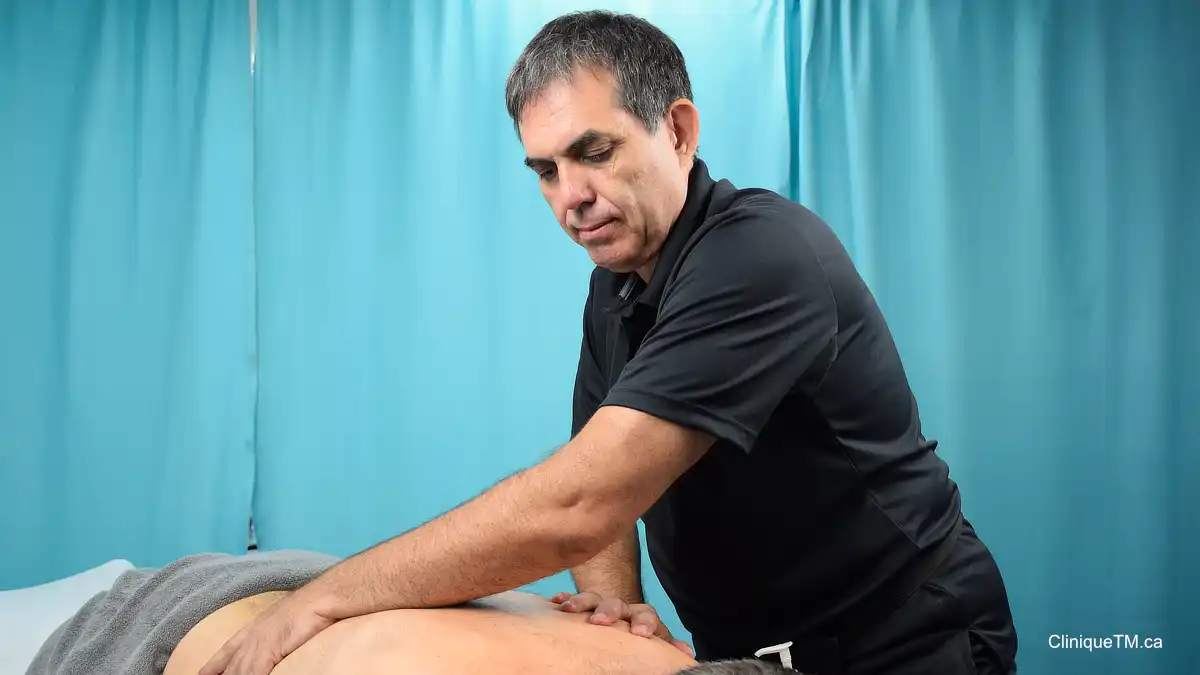
A deep tissue massage session begins with questions about your health. The massage therapist asks about your main complaint. If you have pain, the therapist asks about the character of the pain and how strong it is. You will also be asked about your medical conditions, whether you have had any surgeries, and whether you are being followed by a doctor for any reason — and when you last saw your doctor. All these questions are asked in order to rule out possible contraindications for deep tissue massage.
Professional draping standards are followed throughout the session. Private areas remain covered at all times. If the treatment is focused on the back, for example, you usually do not need to undress completely — only the area being treated is uncovered.
The therapist then uses palpation to find areas of tension, stiffness, density, or reduced mobility, and works on those areas.
A typical session lasts about 45 to 60 minutes.
What to expect after the session
After a deep tissue massage, some soreness or tenderness in the worked area can be normal, especially if the tissue was very tense or stiff. It can feel a bit like after physical work or training.
Some people feel tired or sleepy after the session. Others notice that movement feels easier. These reactions are usually temporary.
Don’t panic. Mild soreness for a day or two does not mean something is wrong. Gentle movement, rest, and normal hydration are usually enough.
If the area feels tender, it is better to avoid heavy training immediately after the massage. Give the body time to respond.
When it may not be appropriate
Deep tissue massage may not be appropriate in cases such as:
- recent injury with uncontrolled inflammation;
- unstable fracture;
- trauma that has not been medically or radiologically assessed;
- severe spasm of unknown cause;
- severe osteoporosis;
- certain post-operative conditions;
- recent cortisone injection, especially near a tendon;
- general tissue weakness related to a pathology;
- uncontrolled inflammatory phase, such as acute inflammatory arthritis;
- fever;
- gout in an acute phase;
- altered sensation due to alcohol, drugs, or peripheral neuropathy;
- thrombosis;
- severe varicose veins;
- muscle rupture;
- skin infection.
If you are not sure whether deep tissue massage is appropriate for you, tell the therapist before the session begins.
Frequently asked questions
What is deep tissue massage?
A focused massage that works slowly on the deeper layers of muscle and connective tissue, aimed at specific areas of tension rather than general relaxation.
How is deep tissue massage different from Swedish massage?
Swedish massage is lighter and aimed at overall relaxation. Deep tissue massage is slower and more focused, with firmer pressure on tight areas — adjusted to each person.
Does deep tissue massage hurt?
It can feel intense, but it should never be sharp or unbearable. The pressure is adjusted throughout the session, and in our clinic the therapist keeps asking how it feels — so don’t endure it in silence, just say if it’s too much.
What are the benefits of deep tissue massage?
It may help with muscle tension, stiffness, ease of movement, and recovery after physical activity. In our clinic, we see it help most with chronic problems and long-standing soft-tissue changes.
What are the after effects of deep tissue massage?
Mild soreness for a day or two, a bit like after exercise, plus a feeling of relaxation. These usually pass on their own — don’t panic.
Can I get a deep tissue massage after a workout?
Yes, but a gentler approach is often better right after hard training. If there is swelling, sharp pain, or a suspected injury, that area should not get deep pressure.
How many sessions do I need?
There is no fixed number. One session can already be useful, while long-standing tension may need more than one visit. The rhythm should fit your goals and what is realistic for you.
References
- Koren Y, Kalichman L. Deep tissue massage: What are we talking about? J Bodyw Mov Ther. 2018 Apr;22(2):247-251. doi: 10.1016/j.jbmt.2017.05.006. Epub 2017 May 17. PMID: 29861215.
- Riggs A. Deep Tissue Massage: A Visual Guide to Techniques. Berkeley, CA: North Atlantic Books; 2002.
- Johnson J. Deep Tissue Massage. Champaign, IL: Human Kinetics; 2011.
- Langevin HM. Fascia Mobility, Proprioception, and Myofascial Pain. Life (Basel). 2021;11(7):668. doi:10.3390/life11070668.
- Pavan PG, Stecco A, Stern R, Stecco C. Painful connections: densification versus fibrosis of fascia. Current Pain and Headache Reports. 2014;18(8):441. doi:10.1007/s11916-014-0441-4.
- Schleip R, Klingler W. Active contractile properties of fascia. Clinical Anatomy. 2019;32(7):891–895. doi:10.1002/ca.23391.